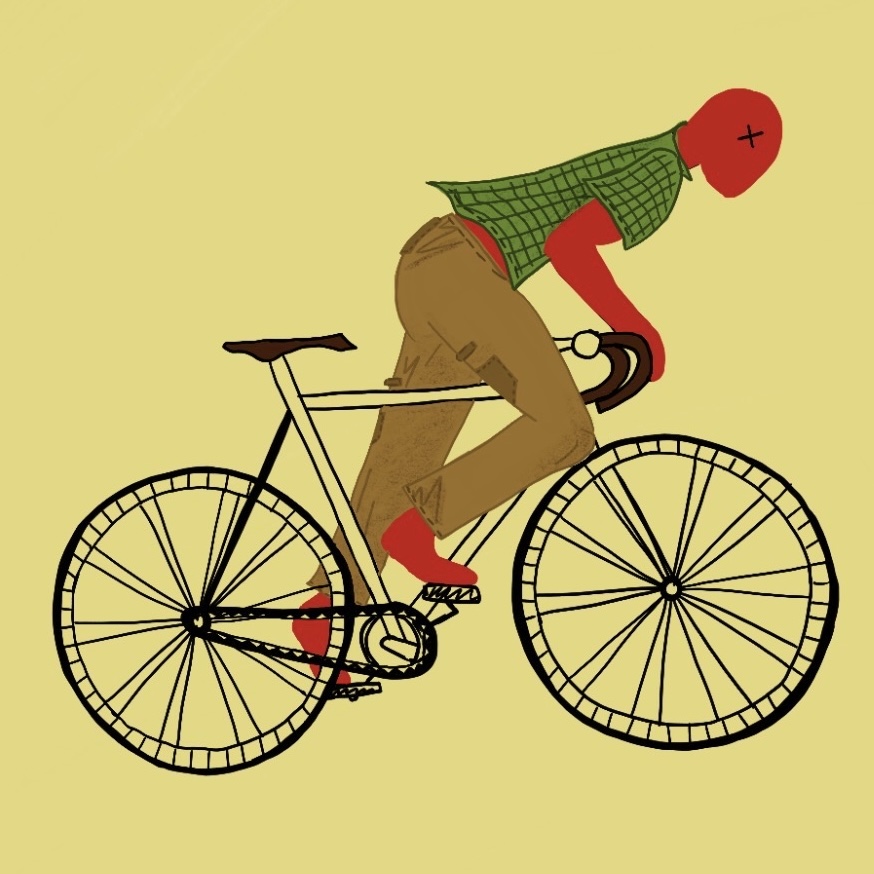
Adaptation
On how bodies change and Charlie Kaufman's Adaptation (2002)
It’s a remarkably still, snow-muffled Sunday night, and I’m seated at the edge of my bed, filing down the always-growing calluses on my hand so that they aren’t torn off the next time my hand slips off of a climbing hold. Gusts of snowy wind against my Somerville house and scratches of an emery board are the only sounds discernable above the noise floor. These calluses are a bodily response, each one an adaptation to a unique stress. Knurled barbells formed the narrow mounds at the base of each finger, guitar strings hardened each fingertip, and plastic rocks calloused the skin near each interphalangal joint. Together, they form an earned and natural gauntlet. Callused hands are hardened to the tasks that hardened them, and they are more useful hence.
A jingling bell on her collar lets me know that the cat’s left her perch on the couch and is trotting down the hallway to come to bed. In the pre-bedtime tranquility, my thoughts wander slowly and aimlessly. The movie I’d just finished watching on the couch not a half hour before still lingers in my mind. Specifically one particularly resonant exchange:
Charlie Kaufman: There was this time in high school. I was watching you out the library window. You were talking to Sarah Marsh.
Donald Kaufman: Oh, God. I was so in love with her.
Charlie Kaufman: I know. And you were flirting with her. And she was being really sweet to you.
Donald Kaufman: I remember that.
Charlie Kaufman: Then, when you walked away, she started making fun of you with Kim Canetti. And it was like they were laughing at me. You didn’t know at all. You seemed so happy.
Donald Kaufman: I knew. I heard them.
Charlie Kaufman: How come you looked so happy?
Donald Kaufman: I loved Sarah, Charles. It was mine, that love. I owned it. Even Sarah didn’t have the right to take it away. I can love whoever I want.
Charlie Kaufman: But she thought you were pathetic.
Donald Kaufman: That was her business, not mine. You are what you love, not what loves you. That’s what I decided a long time ago. What’s up?
Charlie Kaufman: [stunned] Thank you.
Our bodies are in constant turnover. A Theseus’ ship of trillions of cells continuously built up, torn down, and repaired. Plank by plank the ship grows. With each ray of sun and crashing wave the ship decays. The roughest tempests mar it permanently. Over time, a singular ship comes into being, especially designed to cut through the waters it knows best; its hull bearing marks like the pages of an epic.
Bodies grow or morph to the tasks that are asked of them. Or, sometimes they are modified consciously to meet the needs of those who live within them. In some cases they are simply broken down, marked, or stained by our habits. See: the rotundity of the sumo wrestler, the bare chest of the swimmer or the cyclist’s shaved legs. The fingernails of a finger-picking guitar player. The yellow teeth of a smoker. The wrestler’s neck. I once watched a man on TikTok commit himself to daily sessions of crawling on all fours like some kind of missing-link hominid until his forearms—which he showed off by doing gloving-style finger undulations to repeatedly flex and unflex individual forearm muscles—resembled bags of garden snakes writhing in claustrophobic panic. There is another man on TikTok who applies dog medicine to his hands every day and is now capable of sanding a two-by-four with his palms. The body builder leverages his own biology to chisel his own personal Adonis out of his own personal flesh. He is a human foie-gras goose, ballooning into a muscled freak through a régime of machinic exercise, exogenous hormones, and heaps of scrambled eggs, grilled chicken, 93% lean ground beef, rice, and industrially isolated milk proteins. Marathoners, on the other hand, train just as much as bodybuilders, yet they are a twinkish, elven race—alien in comparison to the orcs that populate Gold’s Gym Venice Beach. The marathoner carries no extra weight; aiming for efficiency rather than sheer titanic size. His body is a living locomotive engine whose performance is measured in V02max rather than horsepower. He is an engineer, a mechanic; he knows the exact limits of his respiratory engine, knows how to push those limits, and how to expand them—slowly, each day.
Our bodies are monuments to what we do; our minds libraries of all we see, hear, and read. Within us is contained some impression of each and every thing we have experienced. We are a mosaic of all those that we have loved: vestiges of past loved ones live on within us just like the gifts they have given us that we still hold on to—not necessarily out of remembrance, just: why throw out something perfectly useful?
The body is continuously forged day in and day out through adaptations to that which it is put through. Every callous, muscle fiber, smile line, and scar is exactly where it is, and exactly the way it is because of specific and local stimulus. Aging is simply the result of this daily construction and de/reconstruction: wisdom, wrinkles, injuries. The lines on the face of an aged person contain within them the sum of all expressions they’ve ever made. Of course, the best way we have to prevent and hide these impressions is to numb out, via the botulinum neurotoxin, the expressions that create them. The action is undisentaglable from its effects, its adaptive bodily response.
You are what you choose to eat. You are what choose to you do. You are what you choose to love. Definitions, conceptions, and ideas of you that come from without are simply projections—formless, empty, illusory—onto the concrete flesh-and-blood body and mind that you alone, through continued action alone, can construct. Your body is the truest representation of that to which you commit yourself in each day of your life. Incrementally, your body adapts to what it does, evolving by tweak and blemish into optimized vessel and storied relic. Literally, physically, you are what you love.
—T.M.
Jan 07, 2026