In a slender April rill
A blog post in celebration of the vernal equinox
Can you believe how quickly the snow melts? The filthy white piles that sat along every sidewalk for as long as I can recall are gone—dissipated briefly into wet pavement and dirty fog—in only a few warm days, one spring rain. In the month of March, a sheet of ice thick enough to walk on cracks, crumbles, and frees itself for the first time in months and floats along the Charles and into the harbor; the sun arcs higher into the sky and feels warmer on the skin; people no longer walk hunched and shivered, they eschew their winter jackets and beanies and walk chest up guns out. Ol’ Winter’s loosed his grip on the Northeast and now I’m twenty-seven.
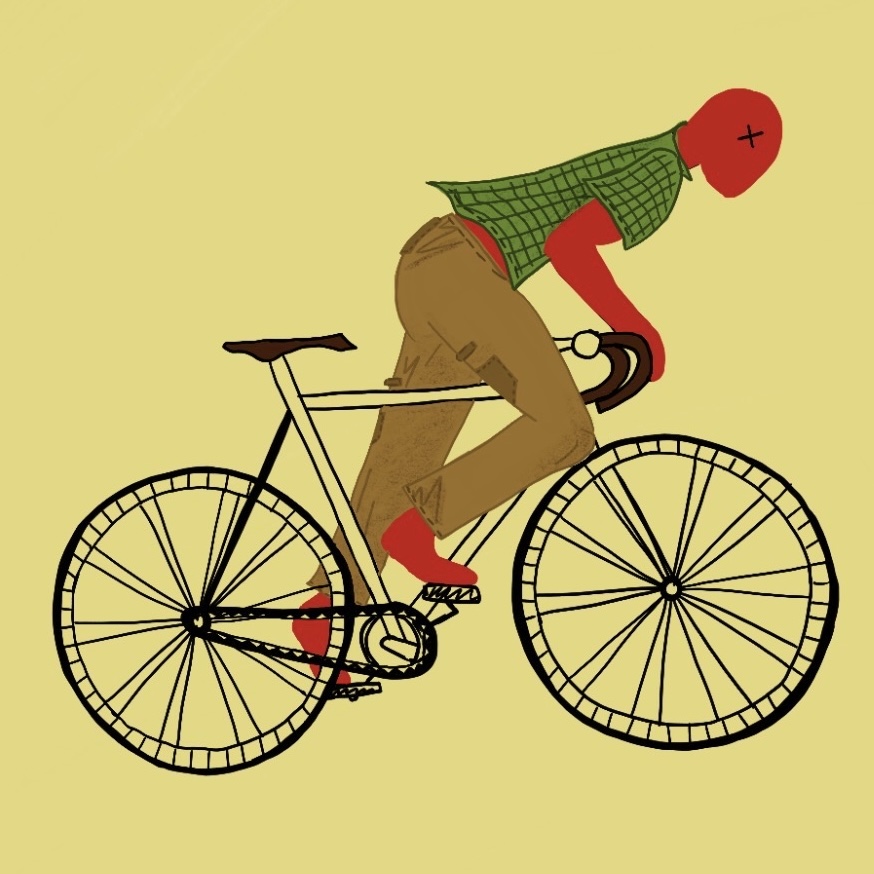
Last year for my birthday I built a bike. A fixie with a 1980s Schwinn gray steel frame and bullhorn handlebars with purple bartape. I’d been wanting a bike like this one for months, so I taught myself how to build one, and spent a few hundred dollars on spare parts and a few dozen hours under a bike stand covered in grease. But thus far it’s been collecting dust in my basement. It’s a fixed-gear bike and the issue is that the 40-tooth to 16-tooth gear ratio I’d committed to is too low of a ratio to be any fun to ride, and plus, the chain tension is too loose and comes off on occasion. I have a 14-tooth cog in my bag of bike parts and I’ve done some calculations that show that this would be a sweet gear ratio1 but the thing is, there’s no way to get the chain tension right with this setup. There is a solution though. I’m just not confident I’m up to the job: I have to grind away the steel frame to extend the drive-side dropout. This would essentially give me full control of the chain tension and solve all of my bike problems.
Well, I did it. I bought a Dremel and slowly cut away and filed smooth an extended dropout. I didn’t have a seat yet but took the bike out for a quick spin anyway—I just couldn’t wait. And it feels great. Fixed-gear bikes are slick; what you sacrifice in sticking to a single gear ratio you gain in elegance, having cut out the need for multiple cogs and chain rings, shifting cables, or shifters on the handlebars. The narrow Chromoly steel tubes are free of cable housings, the handlebars are bare excepting a single brake lever whose short cable just runs directly down to the front brake. Riding one of these bikes feels more biomechanical and less mechanical than riding a regular bike. The bike is less a vehicle and more an extension of your body; you lock your feet into some straps or toe cages and your legs are coupled directly to that rear wheel (like in a unicycle). You can speed up or slow down naturally without ever touching a brake. It’s like running: if you want to go faster you move your legs faster, and if you want to slow down you move them slower.
When I saw the package containing the seat on my front porch I was a kid again. I didn’t even change out of my work clothes; I hooked up the seat as quickly as I could, adjusted the handlebars so they were in a nice, low, aggressive position, and rode it in a loop around the block…then just one more lap before dinner. I felt good. Smile on my face. I skid-stopped on my back tire perfectly before turning off Willow Ave and up Summer Street, bucking my speed just enough to hug the corner. Then all of a sudden the bike drifts slightly to my left, which is weird. I course-correct back into the bike lane but I just drift further to my left and now I’m in front of the white sedan that I passed on the corner. I want to apologize to the driver because I’m in his way. The bike pulls harder to the left what the fuck. I look down and the handlebars are sideways and the front wheel is not sideways. The handlebars are loose—completely decoupled from the fork and front wheel—I have no control over this bike.2 At this point I start emitting these embarrassing, uncontrolled, panicked yelps and woahs. But the adrenaline kicks in and a cooler mind prevails: okay, I’m going to hit the ground, let’s plan for impact. Quickly I scan and lock in on my target. I can’t change the course of the bike much but I can dive off it. I am a bowling ball and my pins are—by the grace of God tomorrow is garbage day—four garbage cans, lined up so perfectly they might as well have rifles on their shoulders.
The fall, and really the whole debacle is elegantly slapstick. I’m laughing as I stuff recyclables back into the cans. Really, the laughter helps soothe the sick feeling in my stomach. I’m lucky this is ultimately just a funny story. It’s really just pure chance that this kind of mechanical failure happened on a quiet road, and that through some municipal coincidence I had a crashpad of plastic cans in my ballistic path. I wasn’t wearing a helmet, and to be honest, I usually don’t. For the past week I’ve been a bit less trusting of the ground under my feet: wary of train derailments, collapsing bridges, broken chairs. I have started wearing a helmet.
Lately, the edges of my consciousness have been cluttered with piles of important papers, bureaucratic deadlines, and dirty dishes. Drifts of dirty snow. I’m looking at some potentially serious change in my future. My living situation for next year is uncertain, and originally I saw this as an opportunity, an excuse to make a change. But somewhere along the way excitement turned to fear. The ground started to shift a bit under me, my handlebars went loose. I did what I typically do when I feel overwhelmed: nothing. The bullshit piles up.
About a month back I’m walking down JFK Street in Harvard Square to meet a friend, ruminating on all of the things I have to do but am not doing, and I unconsciously recall a nebulous fragment of a Robert Frost poem that had wormed its way into my brain of its own volition. The fragment consisted of just the words lets death descend and some sense of the surrounding rhythm of the verse. The section of the The Onset that I was thinking of, in its entirety, is: “I almost stumble looking up and round / As one who overtaken by the end / Gives up his errand and lets death descend / Upon him where he is, with nothing done / To evil, no important triumph won / More than if life had never been begun.” The stanza those lines come from is about someone caught in the first snowfall of the season and I find it to be brilliantly dark, so I spent my idle minutes and hours (waiting for a train, driving, zoning out at work) over the next few days committing the poem to memory.
This is something I’ve been doing lately. I memorized Good-Bye and Keep Cold about two months go—she was my first. And if you are, with a smug and knowing grin, thinking to yourself that you know what may have inspired me to first memorize a poem, you are correct. However! all of the subsequent memorizations (except for one other) have been for my own sake. It’s incredible to find a poem you love and do the work to memorize it. Really it only takes a few days. I treat it like a mental fidget toy that replaces my phone time, but truly it’s a ritual within the great oral tradition. Reciting from memory is the closest you can get to actually holding the wet, squirming, live words of a poem in your hands. You can see the poem in four dimensions. In a way it becomes your own. I could lose everything in a house fire, and be thrown beaten, bruised, head-shaved and naked into some damp dark hole in the ground and be locked away for days but at least I’d be able to recite these poems into the dimensionless black more accurately than I can recall any of my own memories. What you hold in your head is the last thing anyone can take from you.
Always the same when on a fated night
At last the gathered snow lets down as white
As may be in dark woods, and with a song
It shall not make again all winter long
Of hissing on the yet uncovered ground,
I almost stumble looking up and round,
As one who overtaken by the end
Gives up his errand, and lets death descend
Upon him where he is, with nothing done
To evil, no important triumph won,
More than if life had never been begun.
Yet all the precedent is on my side:
I know that winter death has never tried
The earth but it has failed: the snow may heap
In long storms an undrifted four feet deep
As measured against maple, birch and oak,
It cannot check the peeper's silver croak;
And I shall see the snow all go downhill
In water of a slender April rill
That flashes tail through last year's withered brake
And dead weeds, like a disappearing snake.
Nothing will be left white but here a birch,
And there a clump of houses with a church.
On this, the warmer side of March, I find that the latter half of the poem calls out to me in my quiet moments more often than the former. Salt is still caked in the corners of curbs, trash formerly embedded in the plowed snow dots highway medians like glacial erratics, and my taxes aren’t done; but I’m starting to chip away at my neglected tasks and the street sweeps are making their way around town. Just like the birds and the trees, I’m starting to loosen up under the warmer sun. I hope you are too.
Until next time,
—T.M.
April 7 2026